Over the years, we have had a few opportunities to use design to help affect broader social trends. One of these opportunities came in 1963, during the height of the Cold War. At this time, a continuing series of cultural exchange exhibitions took place in the United States and the Soviet Union. The subjects of these exhibitions tended to be non-ideological: medicine, music, or fine art, for example.
The United States Information Agency (USIA), a division of the Department of State, was responsible for U.S. participation. Through the American Institute of Graphic Arts (AIGA), Chermayeff & Geismar was retained to design a large-scale traveling exhibition on all aspects of American graphic arts. The exhibit itself featured thousands of artifacts, from advertising materials, book covers, and illustrations to record album covers, prints, and commercial packaging.
An identity for the exhibit, titled “Graphic Arts USA,” was needed for posters, catalog covers, souvenirs, and other display items. It was important that the identity embody the national aspect of this venture as well as the visual and artistic focus.


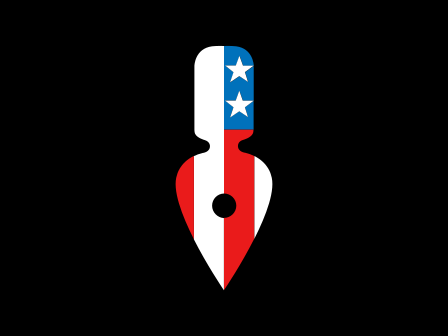
We decided that a design combining two seemingly unrelated ideas—a pen nib and the American flag— would best symbolize the exhibition theme. This image proved to be an effective icon, most notably on the banners outside of the exhibition hall marking the entrance where visitors lined up in the cold to wait for hours.
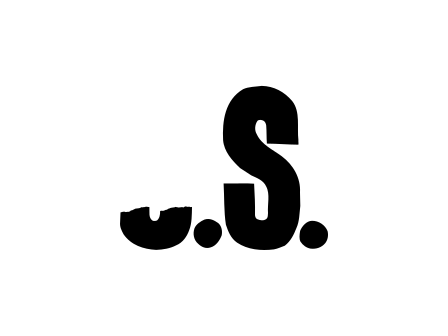
“Graphic Arts USA” turned out to be a great hit, traveling for a number of years within the U.S.S.R. before moving on to the Eastern Bloc. The Soviet authorities may not have foreseen the popular appeal that a graphic arts exhibit might hold. Because it showed images and artifacts from daily life in America, the display was effectively a window into Western culture—and Western commercialism. People lined up for many hours to get a glimpse of this forbidden world. In this respect, graphic art was like an undercover agent, sneaking into the country as art, having an immediate impact as popular culture, and having a long-term influence as social politics.